0bysS
A delay that keeps digging long after the obvious echoes are gone. 0bysS brings those deep, buried repeats forward so you can shape the space behind your sound.
Past the last echo.
Most delays fade away after a few repeats. 0bysS keeps following the feedback much further, then lets you hear and shape the quieter layers that would usually disappear.
Get 0bysS on Gumroad Pay what you want · $18 suggested · VST3 + Standalone · Windows + LinuxSo, what does it do?
Most delays get quieter until the repeats disappear. 0bysS lets you explore the deep echoes that are usually left behind. Bring them forward, shape them, and see where they take the sound.
Curious how it works?
Everyone else stops at the noise floor. 0bysS starts there.
Ordinary delay design treats deep feedback generations as a problem to manage — keep them quiet, keep them out of the way, eventually cut them off. 0bysS's premise is that generations 15–40 aren't garbage, they're a genuinely different kind of material: fully decorrelated, near-mono, and — at high Decay — barely quieter than the generations right above them.
That's measured, not asserted: at Decay 0.999 the spread from generation 15 to generation 40 is 0.4 dB. The whole exposed range is close to one level. Below a certain Decay, the deep generations do fall away — but cleanly, down to silence, never into noise-floor garbage. There's no generation in the 15–40 window that's dead weight you have to avoid; the interface exposes exactly that window because that's exactly where the useful field lives.
One field, weighted, compensated, then blended.
The Recursive cascade runs hidden generations 1–14 as scaffolding — they're never summed, only used to compute what comes after. Generations 15 through REACH are the exposed field. Everything downstream of that field is deliberate shaping; the dry signal never touches any of it until the final RelatioN blend.
Five on the face. RelatioN beside them. A drawer for the rest.
A closer look at the controls
Deep violet, orchid accents. Part of the BeanStalk family.
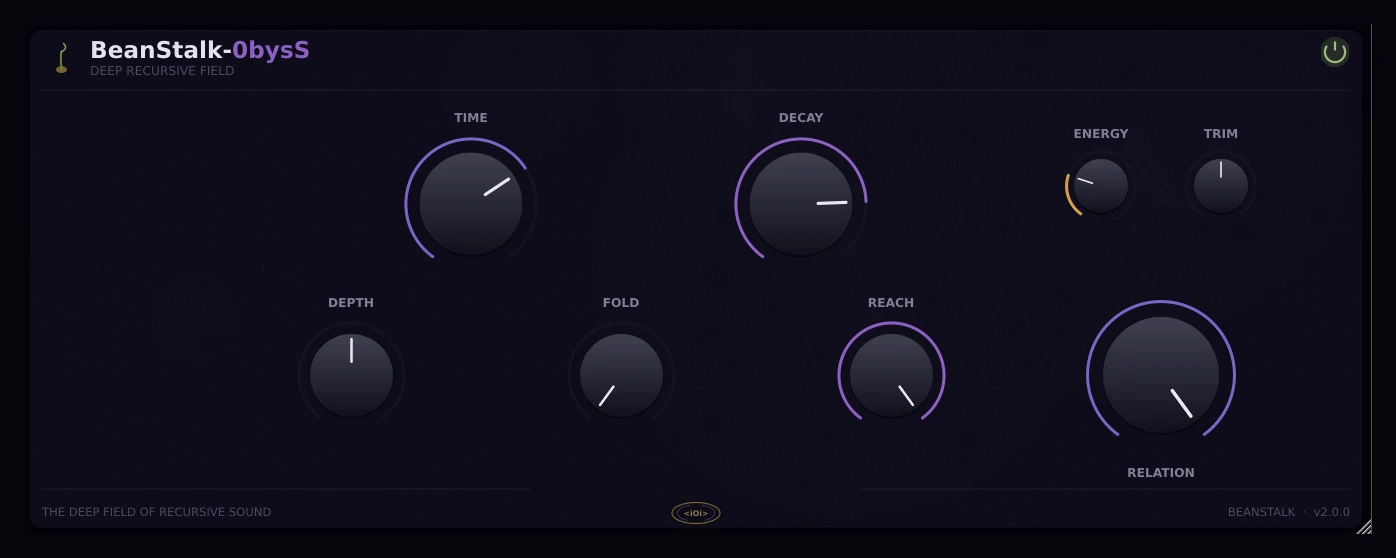
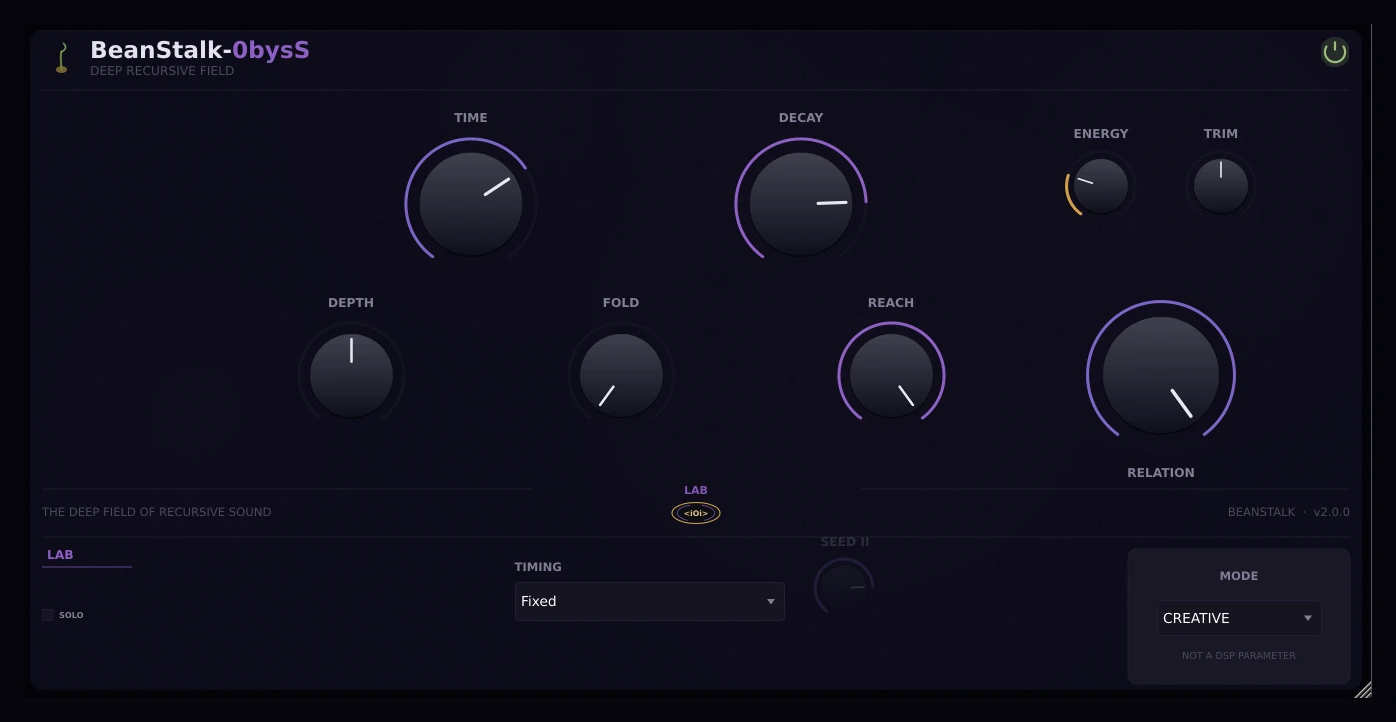
0bysS uses the shared BeanStalk panel with its own cool, blue-violet cast — the deepest, darkest identity in the lineup, appropriate for a plugin about the part of a cascade nobody else exposes. TIME and DECAY lead the top row with ENERGY and TRIM alongside; DEPTH, FOLD and REACH sit below. RELATION is the largest knob on the panel, set apart on the right. The <iOi> badge opens the LAB drawer below for TIMING, SEED II, SOLO, and the MODE control (MASTER/CREATIVE) in its own well.
Where it earns its place.
A few things to know before you download
Read this before you buy.
Technical details and verified specs
Verified specifications.
The field doesn't end where other delays give up.
0bysS is pay-what-you-want with an $18 suggested price. VST3 and Standalone, Windows and Linux — more platforms may follow.
Get 0bysS on GumroadDSP Lineage & Attribution: This plugin incorporates adapted DSP components from Airwindows (Chris Johnson, MIT licensed): BitShiftGain. The specific components and applicable notices are documented in the included THIRD_PARTY_NOTICES.md. This does not imply endorsement by or affiliation with Airwindows.