BeanStalk Plugin

3m0tioNs

Stereo movement without the usual volume-panning trick. Tiny changes in delay make sound shift, lean, and move.

Motion / Modulation

Movement you can feel.

Instead of pushing volume from one speaker to the other, 3m0tioNs moves the timing of the signal in tiny amounts. That creates a different kind of stereo motion.

Get 3m0tioNs on Gumroad Pay what you want · $12 suggested · VST3 + Standalone · Windows + Linux
MOVE
Built byBean.S.talk · BeanStalk Audio
StatusReleased · v1.0.13 · Windows + Linux — more platforms may follow
What is it?

So, what does it do?

Move your stereo sound without simply swinging the volume from side to side. 3m0tioNs gently shifts timing and pitch to make the sound feel alive.

Curious how it works?
The Concept

Four modulators, no shared clock.

Inside 3m0tioNs there are four completely separate modulation engines — one each for Left, Right, Mid and Side. They don't share an LFO and they aren't the same wave offset by a phase amount; each has its own Shape, Rate (0.02–8 Hz), Direction (forward or reverse) and Depth, and its own random seed so the Drift wobble pulls each one a different way. That's what stops the motion sounding mechanical: the two sides of the image are genuinely doing different things, so the result reads as a moving space rather than "there's an LFO on this."

The nine Shapes are the vocabulary. Sine is the classic smooth wobble. Triangle and Trapezoid give a more linear sweep with an optional flat dwell at the extremes. Square and Soft Square snap between two positions — a hard double, or a rounded one. Hexagon, Octagon and Star trace faceted, polygon-like paths for stepped, geometric motion. Random / Drift samples a new target each cycle and glides to it, for movement that never repeats.

SINETRIANGLETRAPEZOID SQUARESOFT SQHEXAGON OCTAGONSTARRANDOM / DRIFT
Signal Path

The modulators set the read position, not the level.

Audio runs through one or two modulated delay stages depending on the Mode; a separate control path shapes each channel's modulation and uses it to offset where that channel's delay is read from. Nothing in the control path is added to the audio — it only steers the delay. A DC and ultrasonic safety filter always sits last, and the moved signal is blended back against the untouched dry by Relation.

SHAPE · RATE · DIRECTION · DEPTH → DELAY READ OFFSET BASE DELAY ± (DEPTH × MAX MOD × SHAPE) · + DRIFT WOBBLE IN STEREO MODULATED DELAY — STAGE A L/R mode: independent L & R · M/S mode: encode → Mid & Side STAGE B — ADVANCED chains M/S after L/R (order switchable) SAFETY FILTER DC / SUBSONIC + ULTRASONIC · ALWAYS ON RELATION WET / DRY / WET−DRY OUT 4 MODULATORS L · R · M · S — independent no shared LFO, own seed PER MODULATOR 9 SHAPES · RATE 0.02–8 Hz DIRECTION fwd/rev · DEPTH 0–1 GLOBAL BASE DELAY 0.5–30 ms MAX MOD 0.1–20 ms · DRIFT 0–1 CONTROL PATH — CARRIES NO AUDIO
Modulated delayEach channel writes into a short circular buffer and reads back from a point that's Base Delay offset by the modulator: Depth × Max Mod × shape value. Reads are Catmull-Rom interpolated to keep fast modulation clean of zipper noise.
Three modesL/R modulates the two channels directly. M/S encodes to Mid/Side, modulates those, decodes back — motion that leaves the centre more stable. Advanced runs an L/R stage and an M/S stage in series, in either order, for compound trajectories.
Drift, not randomnessA small per-sample rate wobble (its own noise seed per channel) rides on top of every shape so nothing sounds like a rigid LFO. It varies the rate, not the depth — the motion stays controlled.
Safety & blendFast delay modulation in some shape/mode combinations can settle to a small DC offset; an always-on DC/subsonic + ultrasonic filter removes it last. Relation then crossfades the result against the bit-untouched dry.
Controls

Per channel, then global.

Shape L / R / M / S9 options eachThe path each modulator traces: Sine, Triangle, Trapezoid, Square, Soft Square, Hexagon, Octagon, Star, Random / Drift. Set the two sides differently and the image starts to move as a space rather than a wobble.
Speed L / R / M / S0.02 – 8 HzHow fast that channel moves. Very slow is environmental drift; a few Hz is obvious spatial movement; up near 8 Hz it becomes texture and flutter. Each channel has its own.
Direction L / R / M / SForward / ReverseRuns that modulator's cycle backwards. Pairing forward on one side with reverse on the other makes the two sides pass through each other instead of moving together.
Depth L / R / M / S0 – 1How far that channel's read position is allowed to travel, as a fraction of Max Mod. At 0 the channel is still; toward 1 it uses the full modulation swing.
Base Delay0.5 – 30 msThe centre delay time the modulation moves around. Short values give a tight doubling/comb character; longer values open into slap-like motion. Not reported as latency.
Max Mod0.1 – 20 msHow many milliseconds the modulation can sweep the delay at Depth 1. Small amounts are subtle pitch shimmer; large amounts are dramatic, seasick pitch movement.
Drift0 – 1The amount of subtle randomised rate wobble layered on every shape. Low keeps things tidy and periodic; higher makes the motion feel organic and alive without becoming random.
ModeL/R · M/S · AdvancedWhich domain the modulation acts in. Advanced chains an L/R and an M/S stage together; Adv. Order switches which runs first.
Relationcentre = dryBlend. Centre is fully dry (silent-of-effect). Turn up to crossfade in the moved signal; turn down past centre to hear only what the motion adds — the wet with the dry subtracted out.
SolotoggleMonitors the full-wet moved signal on its own, ignoring Relation, so you can hear exactly what the modulation is doing while you tune it.
BypasstoggleTrue host bypass — the buffer passes through completely untouched.
A closer look at the controls
The Interface

The motion controls first. Setup behind the <i0i> glyph.

3m0tioNs uses the shared BeanStalk panel — near-black, a bean-sprout mark and the title top-left, a power light top-right — with cyan as its identity hue. The row the plugin is named for sits right under the header: for each channel, a large Depth knob with a smaller Speed knob at its bottom-right, and a ‹ › pair below it for Direction. Relation is the gold, centre-detented knob to the right. Clicking the sprout reveals live value readouts under every control.
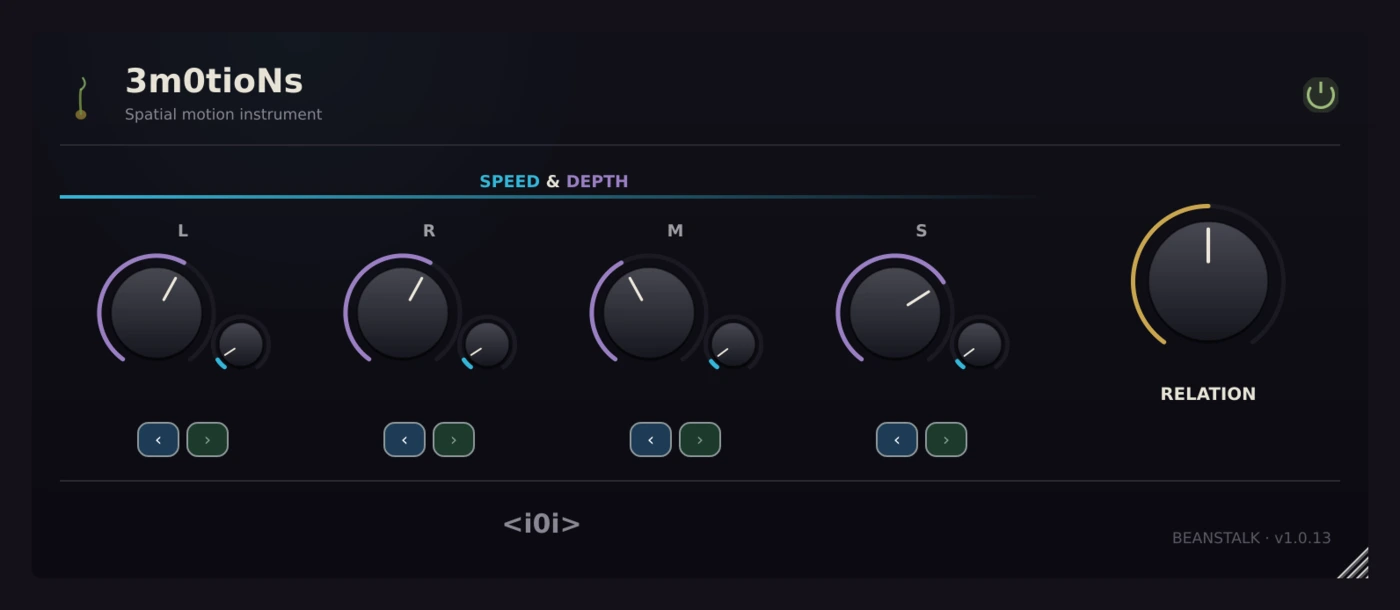
The BeanStalk-3m0tioNs plugin, default view: a wide near-black panel. Top-left a bean-sprout mark, the title '3m0tioNs' in bold cream and the subtitle 'Spatial motion instrument'; a green power light top-right. A 'SPEED & DEPTH' divider — SPEED in cyan, DEPTH in violet — then a row of four large knobs labelled L, R, M and S, each a violet-arc Depth knob with a smaller cyan-arc Speed knob at its bottom-right, and a pair of small left/right direction buttons beneath. At the right, set apart, a large knob with a gold arc labelled RELATION. The bare <i0i> glyph at the centre of the footer and 'BEANSTALK · v1.0.13' at its right.
Default view — the Speed/Depth motion row and Relation. Each channel has a large Depth knob with a small Speed knob at its bottom-right.

The <i0i> glyph in the footer opens a drawer that grows the window downward: Mode (L/R · M/S · Advanced — the L/R First / M/S First switch appears only in Advanced), the global Base Delay, Max Mod and Drift knobs, the four Shape selectors, and the Solo monitor toggle. The window is freely resizable and aspect-locked.
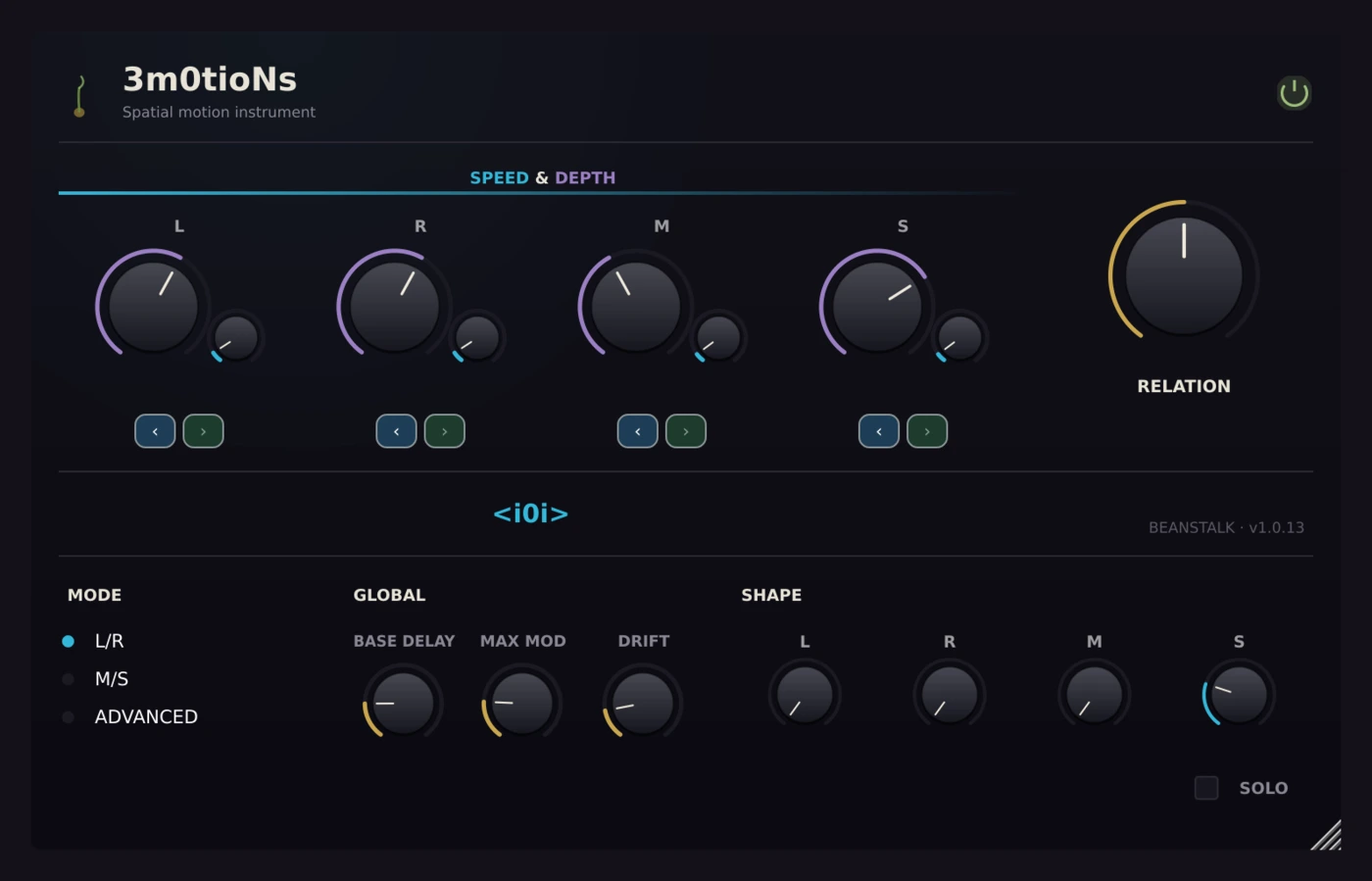
The 3m0tioNs interface with the drawer open (the <i0i> glyph lit cyan): the Speed/Depth row and Relation on top as before, then below the footer divider a second panel. On the left a MODE list with L/R selected and M/S and ADVANCED below. In the centre a GLOBAL section with BASE DELAY, MAX MOD and DRIFT knobs, all with gold arcs. On the right a SHAPE section with four knobs labelled L, R, M, S, and a SOLO checkbox at the lower-right corner.
The drawer open — Mode, the global Base Delay / Max Mod / Drift, the per-channel Shape knobs and Solo.
How to use it

Where it earns its place.

Widen a mono-ish partOn a DI bass, a close-mic'd guitar or a synth, L/R mode with different Shapes per side, small Max Mod, slow Rate: the two sides drift apart and the part occupies more of the image without a stereo-widener's phasey edge.
Tape-style wobbleSine or Triangle, low Rate, Max Mod around 2–4 ms, a little Drift: the classic slow pitch waver of worn tape or a tired tape echo, applied to a whole bus.
Keep the centre solidM/S mode with Depth on Side and almost none on Mid: the ambience and width move while the lead vocal or kick stays locked in the middle.
Rotary / chorus territoryFaster Rate, Square or Soft Square on one channel and Sine on the other, moderate Depth: a swirling, doubled motion closer to a rotary cabinet or a lush chorus.
Sound design and instabilityAdvanced mode, high Max Mod, Star or Random / Drift shapes, opposing Directions: unpredictable, pitch-bending, disorienting motion — well past subtle, for risers, transitions and texture beds.
Just a touch of lifeAny shape, Depth low, Drift up, Relation just past centre: a barely-perceptible movement that stops a static pad or pad-like synth from sitting completely dead in the mix.
A few things to know before you download
What it isn't

Read this before you buy.

Not an autopan or tremoloIt never changes the level of the signal. The movement comes from modulating a delay time, which is why there's always some pitch character to it.
Not a pitch shifterThere's no fundamental tracking and no fixed transposition — the pitch movement is a side effect of sweeping the delay, and it moves with the modulation.
Not a reverb or an echoThe delays are 0.5–30 ms with no feedback path. This adds motion, not space or repeats.
Not monoStereo in / stereo out only. The whole point is the two sides of the image moving independently.
Technical details and verified specs
Technical

Verified specifications.

FormatsVST3 · Standalone application
Operating systemsWindows 10/11 (64-bit) · Linux (64-bit)
BuildsLegacy (broad CPU support) and v3
ChannelsStereo in / stereo out only
LatencyZero reported latency. Base Delay is part of the effect, not lookahead.
Sample ratesAny host rate
Processing32-bit float (double-precision hosts use the host's float fallback)
OversamplingNone. An always-on DC/subsonic + ultrasonic safety filter sits before the output.
BypassTrue host bypass (buffer passes untouched); Relation at centre is also silent-of-effect
CPULight — four LFO-rate modulators and one or two short delay lines per channel
Version1.0.13

Move it. Measure it. Listen to it.

3m0tioNs is pay-what-you-want with a $12 suggested price. VST3 and Standalone, Windows and Linux — more platforms may follow.

Get 3m0tioNs on Gumroad

DSP Lineage: The modulation behavior is inspired by Airwindows Flutter2. No Airwindows code is incorporated.

More BeanStalk plugins

See all plugins →