BeanStalk Plugin

0sZM0s

Make the low end heavier, darker, and stranger without simply turning it up. One main control takes you from subtle weight to a much more transformed sound.

Depth / Harmonic Regeneration

Give the low end another life.

0sZM0s splits the sound into low and high parts. The highs stay put; the lows are reshaped into new harmonics and blended back. Start small, then turn DEPTH to hear how far it goes.

Get 0sZM0s on Gumroad Pay what you want · $18 suggested · VST3 + Standalone · Windows + Linux
ZM0s
Built byBean.S.talk · BeanStalk Audio
StatusReleased · v0.0.3 · Windows + Linux — more platforms may follow
What is it?

So, what does it do?

Want more weight without just turning things up? 0sZM0s takes the low end and grows new harmonics from it. A little adds body; more gets wild fast.

Curious how it works?
The Concept

The fold that opens up instead of clamping down.

Most saturation is compressive: it rounds the peaks, softens transients, adds even/odd harmonics gently. 0sZM0s's fold is the opposite — an arcsine curve that gets steeper as the signal approaches full scale. Fed a driven low band, it doesn't smooth the waveform; it sharpens its slopes and redistributes energy upward and outward. That's the "regeneration": the fundamental you had is spent, and a denser, harmonically richer version takes its place.

Diagram: a vertical DEPTH axis labelled DRY, SHALLOW, DEEP, FULL DEEP. Four stacked waveforms show the progression — a clean sine at DRY where left and right overlap exactly; a slightly folded wave at SHALLOW where the two channels begin to part; a strongly folded wave at DEEP with flattened crests and steep zero-crossings and the channels clearly separated; and a dense, irregular waveform at FULL DEEP where left and right have decorrelated. Side notes give correlation-with-dry falling from 1.00 to 0.46.
DEPTH walks the low band from clean, through harmonic regeneration, into a decorrelated field. The two channels fold differently, so width grows with depth.

There's no auto-limiter — that's deliberate. Past DEPTH ~1.3 or RETURN ~2 the output gets genuinely loud; that's the documented edge of the useful range. SAFE adds an optional soft ceiling if you want to explore past it without watching your meters.

Follow the signal (the nerdy bit)
Signal Flow

Where the low end goes.

The high band passes straight through, untouched. The low band is driven by DEPTH, folded, and recombined as four separate contributions: what's left of the clean fundamental, the folded harmonic form (scaled by RETURN), and a dedicated sub-fill (scaled by WEIGHT). RELATION then sets how the whole result sits against the dry signal.
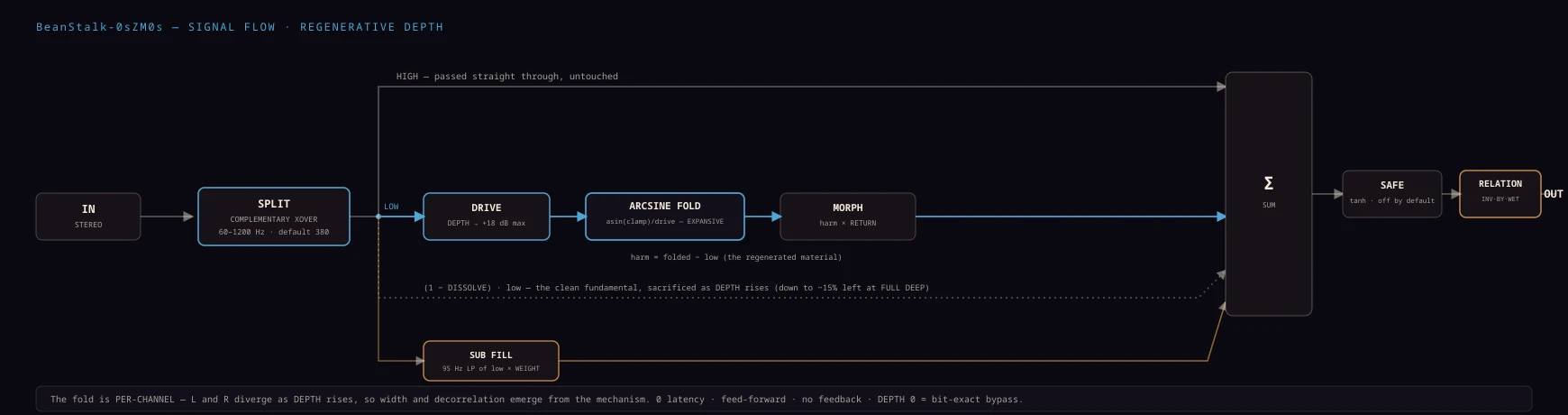
0sZM0s signal flow: stereo input into SPLIT, a complementary crossover from 60 to 1200 Hz (default 380). The HIGH band passes straight to the sum, untouched. The LOW band goes through DRIVE (DEPTH, up to +18 dB), then an ARCSINE FOLD (asin(clamp)/drive, expansive), producing harm = folded minus low. Four things feed the sum: the high band; MORPH which is harm times RETURN; a dashed path carrying (1 minus DISSOLVE) times low — the clean fundamental, sacrificed as DEPTH rises to about 15 percent left at Full Deep; and a SUB FILL, a 95 Hz low-pass of the low band times WEIGHT. The sum passes through an optional SAFE tanh ceiling and then RELATION (INV, BY, WET) to the output. The fold is per-channel, so left and right diverge as DEPTH rises; 0 latency, feed-forward, no feedback, DEPTH 0 is a bit-exact bypass.
The SplitA complementary crossover, 60–1200 Hz, default 380. Everything above it is passed through with no processing at all. SPLIT sets how much of the sound is eligible for regeneration — think of it as reach, or darkness.
The FoldThe driven low band goes through asin(clamp(x))/drive — unity-referenced, so it's a passthrough at DEPTH 0 and progressively more expansive as DEPTH raises the drive. This is the harmonic generator.
The TradeAs DEPTH rises, DISSOLVE removes up to ~85% of the clean low fundamental and MORPH (× RETURN) brings the folded version back in its place. WEIGHT independently keeps a 95 Hz sub-fill so the bottom never hollows out.
Width for freeNothing here is a stereo effect. But the fold runs separately per channel, and a driven nonlinearity diverges faster the harder it's pushed — so L and R decorrelate on their own as you go deeper.
Controls

One macro. Four shapers. Two switches.

DepthDRY → SHALLOW → DEEP → FULL DEEPThe one macro. Drives the low band, folds it, and trades the clean fundamental for the folded form — all at once. Zero is a bit-exact bypass. The readout names the region you're in, not a percentage, so you always know which regime you're auditioning.
Return0 – 2×, default 1×How much of the regenerated band comes back. 1× is the natural setting; below it the effect is subtler; above 1× is controlled-instability territory — the folded material outweighs what it replaced.
Split60 – 1200 Hz, default 380The crossover. Lower keeps the regeneration tight to the sub; higher lets it reach up into the low mids. The band above SPLIT is never touched.
Weight0 – 100%, default 100%The sub-fill. A 95 Hz low-pass of the original low band, mixed back in independently of everything else. Turn it down if the bottom gets too heavy as DEPTH rises; turn it off entirely for a leaner, more mid-forward result.
RelationINV · BY · WETHow the processed signal relates to the dry. WET is the full effect. BY is a true bypass (bit-exact dry). INV inverts the contribution — it carves out what 0sZM0s adds instead of adding it, for parallel and subtractive tricks.
Safe / Soloboth off by defaultSAFE is an optional tanh ceiling for exploring past the loud edge of the range. SOLO monitors only what the engine generated, at its real RELATION level — a listening tool for setting DEPTH by ear.
A closer look at the controls
The Interface

Five knobs, left to right, deep to detail.

DEPTH is the large macro on the left; RETURN, SPLIT and WEIGHT shape it; RELATION (in warm amber, bipolar) sits at the end. SAFE and SOLO are checkboxes. The readout under DEPTH names the region. Part of the BeanStalk family visual system — 0sZM0s's identity hue is blue.
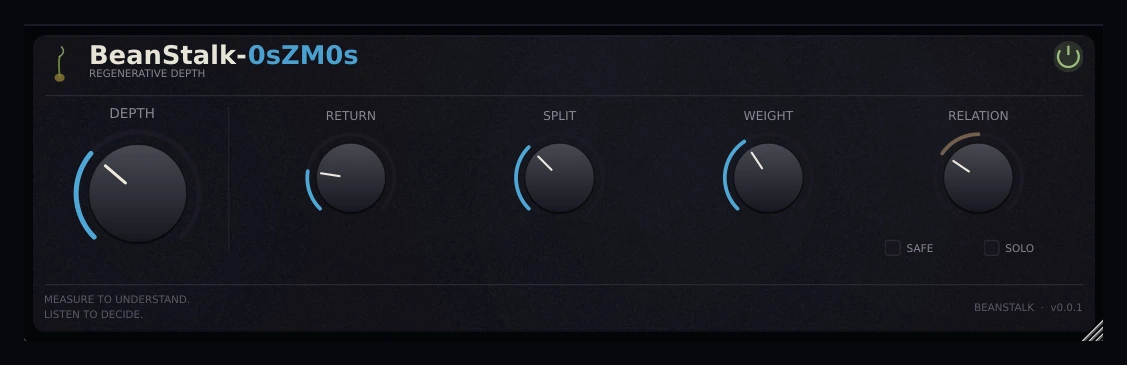
The BeanStalk-0sZM0s plugin interface: a wide near-black panel. Top-left a small bean-sprout mark, then the title 'BeanStalk-0sZM0s' in cream and blue with the subtitle 'Regenerative Depth'. A green power light at top-right. Five knobs in a row: a large DEPTH knob with a blue arc, then smaller RETURN, SPLIT and WEIGHT knobs also with blue arcs, and a RELATION knob with a warm amber arc pointing near centre. Two checkboxes at lower right, SAFE and SOLO. The footer reads 'Measure to understand. Listen to decide.' on the left and 'BeanStalk · v0.0.1' on the right.
Resizable and aspect-locked, on the BeanStalk vector template.
How to use it

Where it earns its place.

Bass that needs body, not volumeA DI bass or sub-heavy synth that's loud enough but feels thin. A little DEPTH regenerates harmonics an octave or two up from the fundamental — it reads as bigger and more present without touching the fader.
Drum bus weightLow-to-moderate DEPTH on a drum bus thickens the kick and low toms and adds a subtle width to the whole kit as the channels decorrelate. Pull WEIGHT back if the sub piles up.
Making a full mix "descend"The original use case: a gentle DEPTH on a mix bus makes it darker, denser and a touch wider at the same loudness. Use RELATION → BY to A/B honestly, or SOLO to hear exactly what's being added.
Sound design & dronesHigh DEPTH and RETURN past 1× turn a simple low tone into a churning, decorrelated field. This is the loud, unstable end — SAFE on, and mind your levels.
Parallel regenerationOn an aux with RELATION at WET, blend to taste. Or RELATION → INV on the source track to subtract the regenerated band — a way to thin a sound out by removing the harmonics 0sZM0s would have added.
Guitars & keys with weak low midsRaise SPLIT toward 600–800 Hz so the fold reaches into the low mids, then a modest DEPTH to fill in a hollow-sounding electric piano or clean guitar.
A few things to know before you download
What it isn't

Read this before you buy.

Not a gentle tape/tube saturatorThe fold is expansive, not compressive. It sharpens slopes and generates upper harmonics rather than rounding peaks. At low DEPTH it's subtle; it is not a "warmth" plugin.
Not level-safe on its ownNo auto-limiter by design. Past DEPTH ~1.3 or RETURN ~2 it gets loud. SAFE adds a tanh ceiling; use it, or a limiter after, if you push hard.
Not a stereo widenerThe width is a side effect of per-channel folding, not a mid/side tool. You get more of it by going deeper, not by a dedicated control.
Not mono, not zero-thoughtStereo in / stereo out only. And it rewards setting SPLIT and WEIGHT for the source rather than leaving them at default.
Technical details and verified specs
Technical

Verified specifications.

FormatsVST3 · Standalone application
Operating systemsWindows 10/11 (64-bit) · Linux (64-bit)
BuildsLegacy (broad CPU support) and v3 (AVX2; includes the Standalone)
ChannelsStereo in / stereo out only
LatencyZero. Feed-forward, no feedback, no lookahead.
Sample ratesAny host rate; character verified identical at 44.1 / 48 / 96 kHz
OversamplingNone. Regeneration is a real mechanism, not aliasing (verified against 96 kHz).
BypassHost bypass, plus DEPTH 0 and RELATION → BY are both bit-exact dry inside the plugin
StabilitySilence→silence; DC / impulse / full-scale bounded; no NaN/Inf even at DEPTH 5 / RETURN 5
CPULight — a crossover, one waveshaper, a sub filter per channel. No FFT, no oversampling.
Version0.0.3

Measure to understand. Listen to decide.

0sZM0s is pay-what-you-want with an $18 suggested price. VST3 and Standalone, Windows and Linux — more platforms may follow.

Get 0sZM0s on Gumroad

More BeanStalk plugins

See all plugins →