BeanStalk Plugin

L0wPasS

A low-pass filter that doesn't throw everything away. It takes the highs you cut and gives you ways to bring some of their character back.

Filter · Harmonics · Air · Ceiling

Cut the highs. Keep the character.

Turn the cutoff down to filter the signal. L0wPasS also tracks the difference between the original and filtered sound, then uses that removed material for its extra processing.

Get L0wPasS on Gumroad Pay what you want · free · VST3 + Standalone · Windows + Linux
L0wPasS
Built byBean.S.talk · BeanStalk Audio
Statusv0.1.0 · Windows + Linux — more platforms may follow
What is it?

So, what does it do?

Turn down the highs, then explore some of the character that got taken away. L0wPasS gives you more to play with than a plain low-pass filter.

Curious how it works?
The concept

The highs go. Their harmonics stay.

Below: a sawtooth through the plugin's own DSP. With the cutoff closed the plain lowpass drops the highs by tens of dB. Switch the exciter on and that region comes back — not as the original highs, but as harmonic content generated from them.
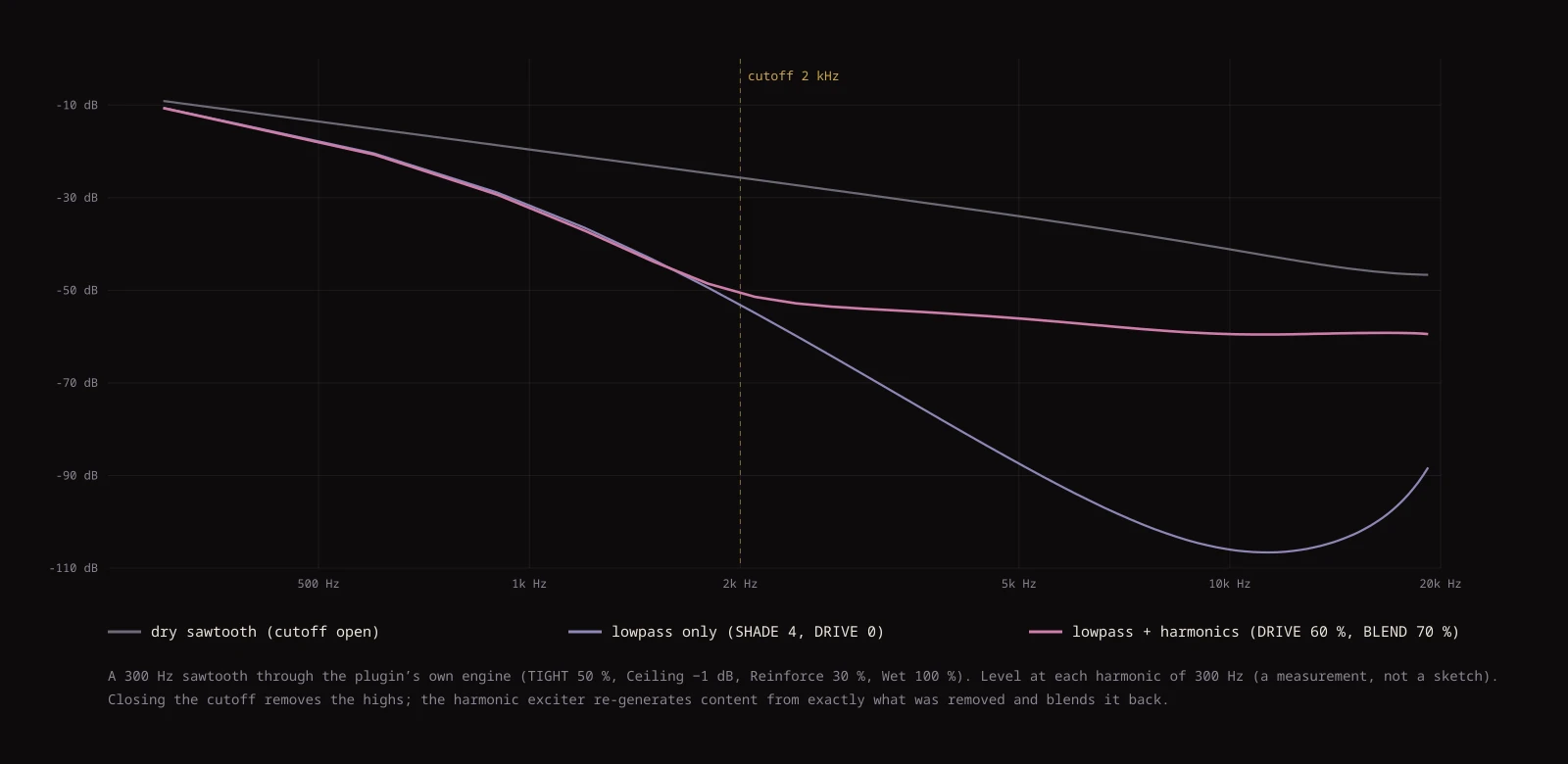
A spectrum chart from 250 Hz to 20 kHz on a dark background with three curves. A grey line shows a dry sawtooth falling gently across the band. A dusk-violet line shows the lowpass-only result: it follows the dry curve below 2 kHz then falls steeply to about minus 105 dB. A pink line shows lowpass plus harmonics: it also leaves the dry curve at 2 kHz but stays near minus 55 to minus 60 dB across the upper band.
A measurement, not a sketch: a 300 Hz sawtooth through the plugin's own engine at cutoff 2 kHz, SHADE 4. Dry, lowpass only (DRIVE 0), and lowpass with harmonics (DRIVE 60 %, BLEND 70 %). The lowpass-only curve lifts near 20 kHz: that is the auto air shelf.

The regenerated content isn't confined to below the cutoff; the exciter's harmonics land above it as well. It is quiet next to the dry signal — a texture, not a restoration.

Signal flow

Nothing is just subtracted.

Every bit of high end L0wPasS removes gets measured, re-synthesised as harmonic content, and offered back before the signal reaches the output stage.

LOWPASSED DRY − LOWPASSED + BLEND · M/S ROUTE DRY IN STEREO LOWPASS CORE TIGHT · UP TO 4 STAGES SUMMED LOWPASS + HARMONICS AUTO AIR SHELF RISES AS CUTOFF FALLS CEILING LIMITER −3 TO −0.5 dB, PHASE-CANCEL SAFETY CLIP CLIPONLY3, RARELY ENGAGES MIX DRY / WET TRIM GAIN OUTPUT dB OUT DIFF WHAT GOT REMOVED HIGHPASS TRACKS CUTOFF PAFNUTY HARMONICS CHEBYSHEV EXCITER
Lowpass coreAn Airwindows-lineage Lowpass2 core with amplitude-tracking Tight and up to four progressive filter stages — more stages mean a steeper, more characterful rolloff, not just a lower number.
The reinforcement loopThe material the filter removed is high-passed (tracking the cutoff), run through Chebyshev-style harmonic generation (2nd–6th), steered by Even/Odd, Near/Far and the Mid/Side send, and blended back.
Auto air shelfA high shelf that slides between 6 and 16 kHz and climbs in gain as the cutoff comes down, so an aggressive setting doesn't have to mean a dull one.
Ceiling + safetyA phase-cancellation ceiling (−3 to −0.5 dB) cancels what pokes over, blending a softened fraction back as Reinforce, backed by a fixed safety clip that should rarely engage.
Controls

Filter. Harmonics. Ceiling. Output.

CUTOFF20 Hz – 20 kHz · opens at 20 kHzThe lowpass frequency. Fully open by default.
TIGHT0 – 100 % · default 50The amplitude-tracking offset from the Lowpass2 core.
SHADE0 – 4 stagesProgressive filter-stage engagement. More stages: a steeper, more characterful slope.
DRIVE0 – 100 % · default 0How hard the exciter works on the removed highs.
EVEN/ODD · NEAR/FARbipolar macrosTwo balances that steer which harmonics you get — odd or even, near (2nd–3rd) or far — instead of ten sliders.
BLEND0 – 100 % · default 50How much generated harmonic content is summed back in.
MID / SIDEbipolar send · centre = offSteers the harmonic content toward the centre or the edges of the stereo image.
THRESH−3 … −0.5 dB · default −1The ceiling. Anything over it is cancelled by an inverted-phase correction.
REINFORCE0 – 100 % · default 30Blends a softened fraction of what the ceiling cancelled back in, so it can glue rather than only chop.
WET · TRIM · ØoutputDry/wet for the whole chain, ±12 dB output trim, and a polarity invert.
The bean-sprout marktop-leftClick to reveal every numeric readout, plus a live AIR reading and a LIMITER strip. Dormant by default.
The <i0i> markfooter, dead centreClick to open the drawer: an AUTO | AIR4 test toggle for the air shelf.
BYPASSheader power lightGreen while on, dim grey when bypassed. A straight pass-through.
A closer look at the controls
The Interface

Hibiscus and dark. Part of the BeanStalk family.

The panel opens compact, with the values hidden. The whole thing scales as one — every label, knob and toggle grows and shrinks together.
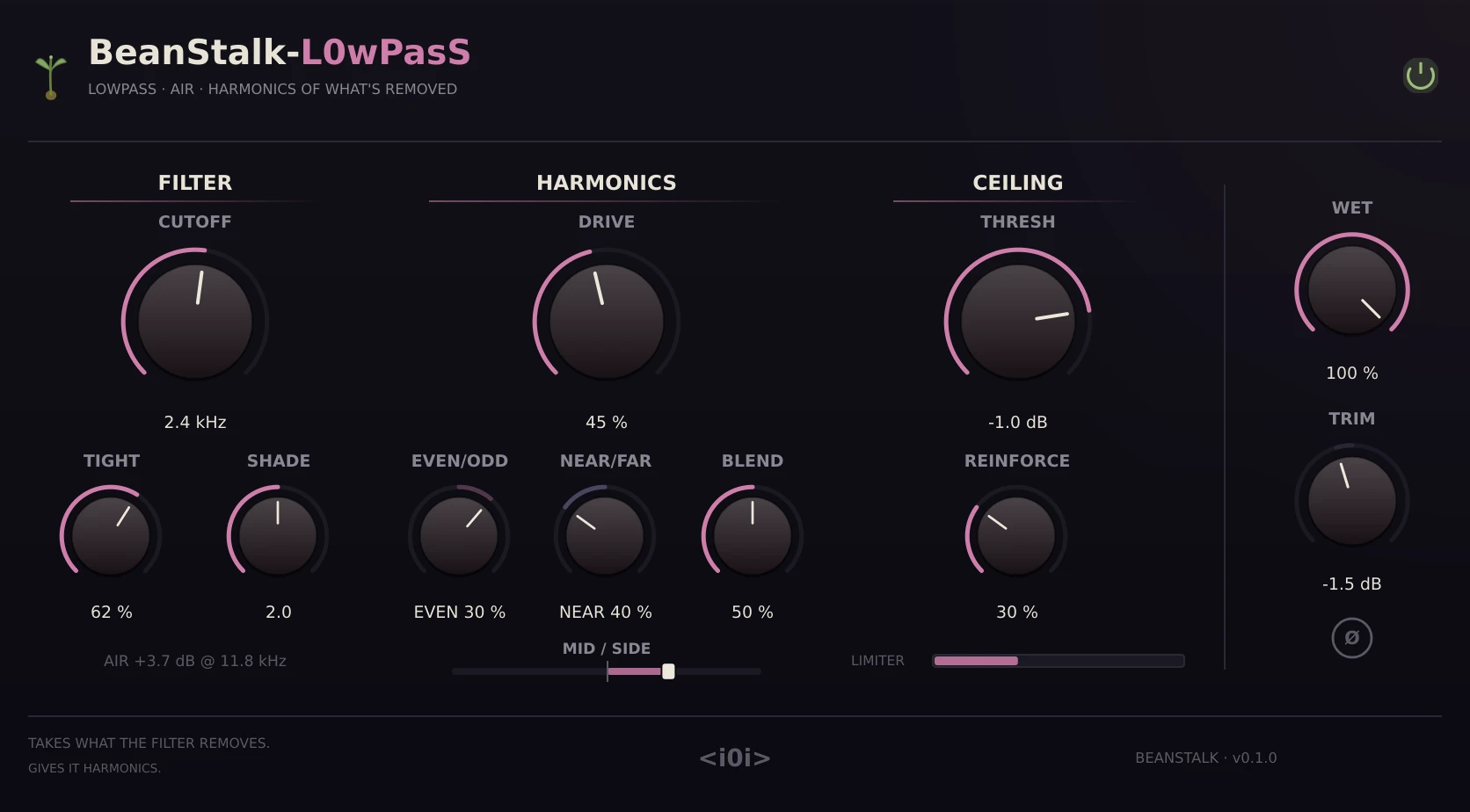
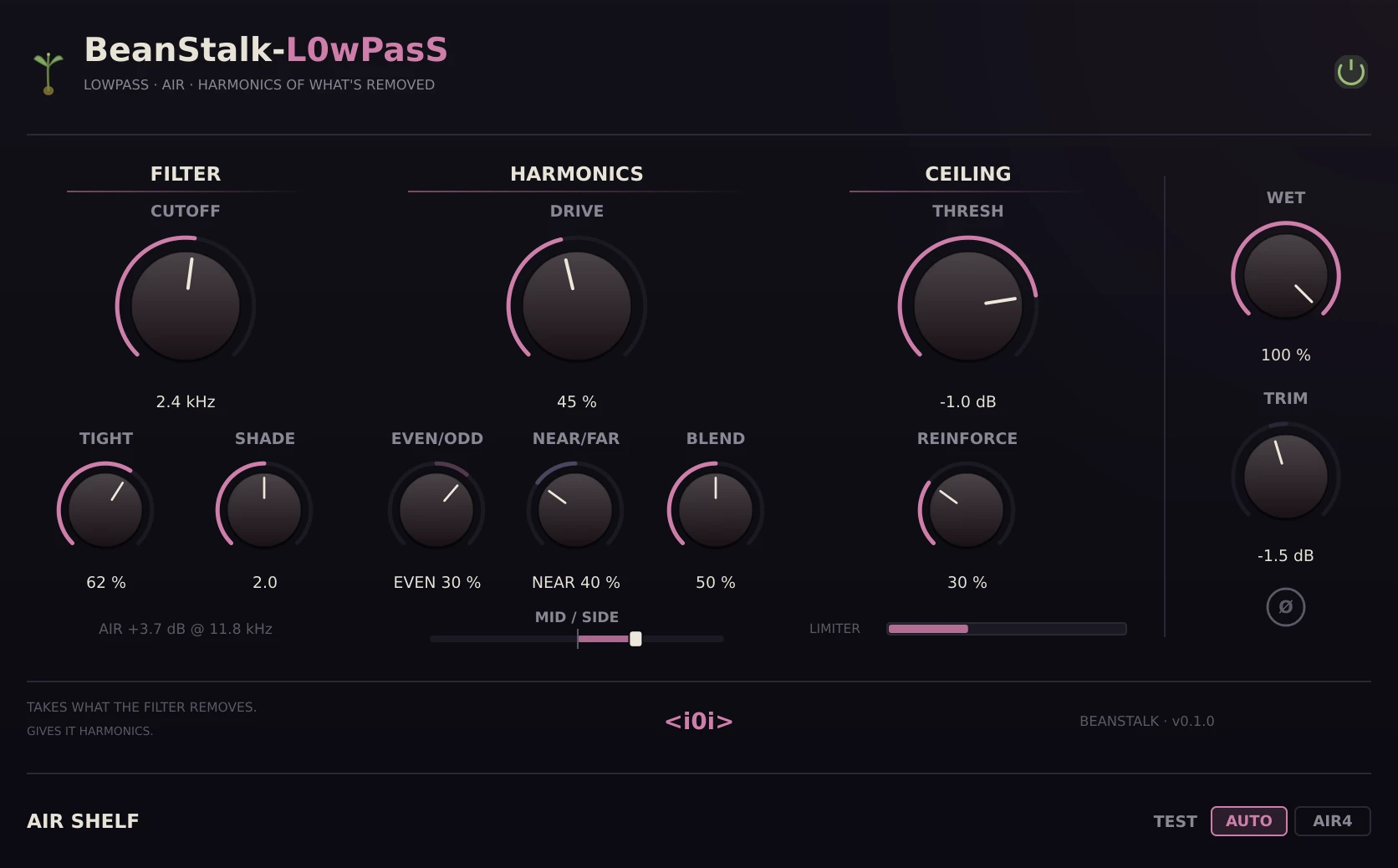
The BeanStalk-L0wPasS front panel: a dark bar with the title in cream and hibiscus pink, a bean-sprout mark at top-left and a green power light at top-right. Four groups: FILTER with a large CUTOFF knob and TIGHT and SHADE below; HARMONICS with a large DRIVE knob, EVEN/ODD, NEAR/FAR and BLEND, and a MID / SIDE bar; CEILING with a large THRESH knob, REINFORCE and a LIMITER strip; and WET, TRIM and a polarity symbol after a divider. The footer has the i0i mark at the centre.
The front panel with the readouts shown (a render of the plugin's own editor; demo settings).
The same panel with the drawer open below the footer: an AIR SHELF section with a TEST label and AUTO and AIR4 switches.
The drawer — the AIR SHELF test toggle. Same window, just taller.
How to use it

Where it earns its place.

Darken without dullingPull the CUTOFF down on a bright synth or bus, then raise DRIVE and BLEND until the top end returns as texture instead of sizzle.
Steer the harmonicsEVEN/ODD and NEAR/FAR change the character of what comes back: warmer, edgier, closer, further.
Keep the centre cleanUse MID / SIDE to send the harmonic content toward the edges, or collapse it to the middle.
Slope it your waySHADE and TIGHT change how the filter slopes and reacts: gentle roll-off at low settings, steeper and more characterful at high ones.
Catch what runs hotThe ceiling cancels peaks over THRESH; raise REINFORCE for a glued feel, lower it for a cleaner ceiling.
Blend it inWET brings the whole chain in against the dry signal for parallel use.
A few things to know before you download
What it isn't

Read this before you download.

Not a true-peak limiterThe ceiling is a phase-cancellation design with first-pass attack and release values. In the plugin's own test render the output peaked about 0.4 dB over full scale at extreme settings. Leave headroom.
Not a restorationThe regenerated harmonics are a texture, quiet compared with the dry highs — not the original highs returned.
The air shelf follows the cutoffIt rises on its own as you close the filter. There is no manual air control; the drawer only swaps between two shelf engines for testing.
Hard bypassBypass is a straight pass-through, not a crossfade.
Early releasev0.1.0 of the new interface. The DSP has been measured and tested, but it has not been run in every host.
Technical details and verified specs
Technical

Verified specifications.

FormatsVST3 · Standalone application
Operating systemsWindows (64-bit) · Linux (64-bit)
ChannelsStereo in, stereo out
Latency0 samples reported to the host
ProcessingDouble precision inside the plugin
CPU≈ 0.34 % of one core at 48 kHz at defaults (measured, v0.0.13 benchmark)
Ceiling−3 … −0.5 dB, phase-cancellation; not a true-peak limiter
BypassStraight pass-through
AutomationAll controls, Invert, Air-shelf mode and bypass are host-automatable
BuildsTwo tiers per platform: a legacy VST3 for any 64-bit CPU, and a VST3 + Standalone build for CPUs with AVX2
Version0.1.0

DSP lineage: Lowpass2, Pafnuty2, ClipOnly3, Air4 and PurestGain are adapted from Airwindows (Chris Johnson, MIT licensed); the notice is included with the download. The ceiling limiter and the auto air shelf are not Airwindows ports. This does not imply endorsement by or affiliation with Airwindows.

Nothing is just subtracted.

L0wPasS is pay-what-you-want, and free is a fair price. A lowpass that keeps what it takes — VST3 and Standalone, Windows and Linux. More platforms may follow.

Get L0wPasS on Gumroad

More BeanStalk plugins

See all plugins →