BeanStalk Plugin

LIFE

A harmonic engine that follows the low end and grows something new above it. This is the original LIFE engine, on its own.

Harmonic Field

The original LIFE, set free.

LIFE listens across narrow bands in the bass, builds harmonics from what it finds, and blends them into the signal. It's the earlier engine that started inside BBeQ.

Get LIFE on Gumroad VST3 · Windows + Linux · more platforms may follow
LIFE
Built byBean.S.talk · BeanStalk Audio
Statusv0.2.0 · Windows + Linux. More platforms may follow.
What is it?

So, what does it do?

LIFE listens to the low end and grows new harmonics from it. Bring those new tones in gently, or push them until the sound becomes something else.

Curious how it works?
The Concept

Not an exciter. A field that blooms with the music.

LIFE splits the low end into 45 narrow constant-Q bands (12 per octave, 30–400 Hz). It doubles the frequency of each band's own sliver, passes it through a low-order Chebyshev waveshaper (Airwindows Pafnuty2, 3–5 orders as the knob rises), and adds the result under the untouched signal. The field follows the source's own level, so it doesn't pump. At full LIFE it targets roughly −12 dB under the source: present, never shouting.

Left of 12 o'clock, the same field is subtracted instead of added. The new upper harmonics are the same, but where the field overlaps your low end it pulls against it instead of building on it. On a bass the left side sounds leaner; on a kick it can bring out more body. Moving through 12 o'clock is click-free: the field fades out, flips and fades back in.

Signal Path

The dry signal never changes.

The field is built from a copy of your signal and added to the untouched dry signal, or subtracted from it to the left of 12 o'clock. At 12 o'clock the output is the input, bit for bit.

DRY — untouched INSTEREO 45 BANDS12/OCT · 30–400 Hz DOUBLEREACH BAND'S OCTAVE PAFNUTYLOW-ORDER CHEBYSHEV ± FIELDLIFE −100…+100 SOLOFIELD ONLY · OR OFF OUT host Bypass = untouched input
45 bands, one knobThe knob scales waveshaper order (3, 4 from 25%, 5 from 75%) and drive between two measured, musical endpoints. Band envelopes are shared between left and right, so the stereo image isn't smeared.
Blue: REFThe original BBeQ 0.3 voicing. Laid back, and the default.
Red: HI+LOMore drive on the bands above 150 Hz, for more upper harmonics. Envelopes on the bands below 100 Hz release within one cycle, giving low notes a grittier octave. More aggressive.
Solo means soloWith Solo on, LIFE outputs only the field, the part it adds or subtracts.
Controls

One knob, two pills, one switch.

LIFE−100% … +100%, default 0 (dry)Right adds the field, left adds it upside down, and 12 o'clock is the untouched input. Double-click to return to dry.
Blue / red pillsREF · HI+LOThe voicing: blue is the original and laid back, red is more aggressive. The LIFE ring takes the pill's colour.
SOLOtogglePlays the field on its own.
Interface

Aqua, with a dry dot at 12 o'clock.

One row: the voicing pills, a large tripolar LIFE knob and SOLO. A small dot on the ring marks 12 o'clock, and the ring grows from it in either direction as a gradient of the lit pill's colour. It is drawn with vector primitives in the shared BeanStalk family style, resizable and aspect-locked.
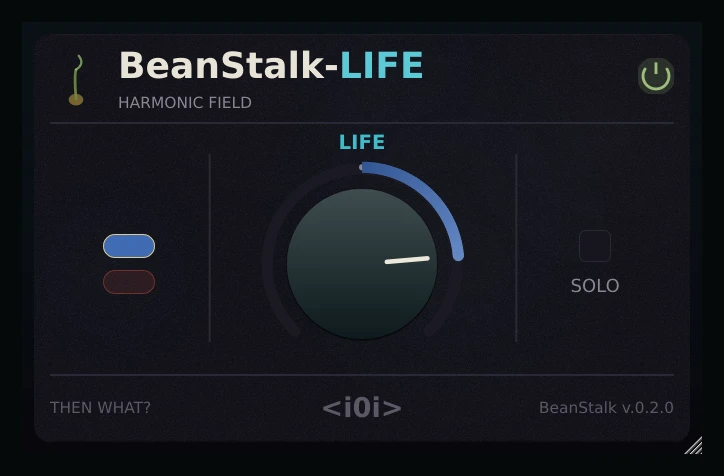
The BeanStalk-LIFE front panel: a compact near-black panel. Top left, a small bean-sprout mark; the title 'BeanStalk-LIFE' with 'LIFE' in aqua and the subtitle 'HARMONIC FIELD'; a power icon top right. Left, two small pills, blue lit and red unlit; centre, a large LIFE knob with a blue arc from 12 o'clock to the right; right, a SOLO checkbox. Footer: 'THEN WHAT?', a centred '<i0i>' and 'BeanStalk v.0.2.0'.
The front panel: the voicing pills, the tripolar LIFE knob and SOLO.
A few things to know before you download
What it isn't

Read this before you download.

One note at a timeLIFE suits single notes in the low end, like bass and kick. Chords or a full mix in the low end produce inharmonic intermodulation.
It has stepsThe character changes at 25% and 75% on either side. The level jumps there (about +7 dB and +2 dB), and a fast move across a step can click on a sustained bass. This is the original engine's behaviour, kept on purpose.
Restarts can make it louderAfter the host restarts audio, the field can play up to about 7 dB louder until the knob next crosses 25% or 75%. This is inherited from BBeQ 0.3, bit for bit.
It costs CPU when onAbout 11% of one core at 48 kHz at full LIFE, and about 42% at 192 kHz. Almost nothing at 12 o'clock.
No output limiterWatch your levels.
Technical details and verified specs
Technical

Verified specifications.

FormatVST3
Operating systemsWindows (64-bit) · Linux (64-bit)
ChannelsStereo in / stereo out
LatencyNone
Sample ratesAny host rate; tested at 44.1 / 48 / 88.2 / 96 / 176.4 / 192 kHz
OversamplingNone
Neutral behaviour12 o'clock and Bypass are the input, bit for bit
Version0.2.0

Harmonic field. Then what?

VST3, Windows and Linux. More platforms may follow.

Get LIFE on Gumroad

DSP Lineage & Attribution: This plugin incorporates adapted DSP components from Airwindows (Chris Johnson, MIT licensed): Pafnuty2. The specific components and applicable notices are documented in the included THIRD_PARTY_NOTICES.md. This does not imply endorsement by or affiliation with Airwindows.

More BeanStalk plugins

See all plugins →