BeanStalk Plugin

z0mBi

Wait for the weight. z0mBi hears a strike, then puts weight under it.

Strike, then weight

Timing is everything. Weight is the payoff.

A stick on a head, a pick on a string, the crack of a snare: z0mBi finds the strike, waits for the Delay you choose, and swells the low end under it. Your own low end, or a new sub thump built from the hit.

Get z0mBi on Gumroad VST3 · Windows + Linux · more platforms may follow
z0mBi
Built byBean.S.talk · BeanStalk Audio
Statusv0.2.0 · Windows + Linux. More platforms may follow.
What is it?

So, what does it do?

z0mBi listens to the high end for strikes. When it hears one, it waits a moment and opens a weight under it: the low end swells, then fades. The weight follows the playing, so it lands where the hits land and stays out of the way where they don't.

Use it on live drums, picked guitars, percussive hits and dense mixes, whenever the hit has the snap but not the floor.

Curious how it works?
The Concept

The hit is the cue.

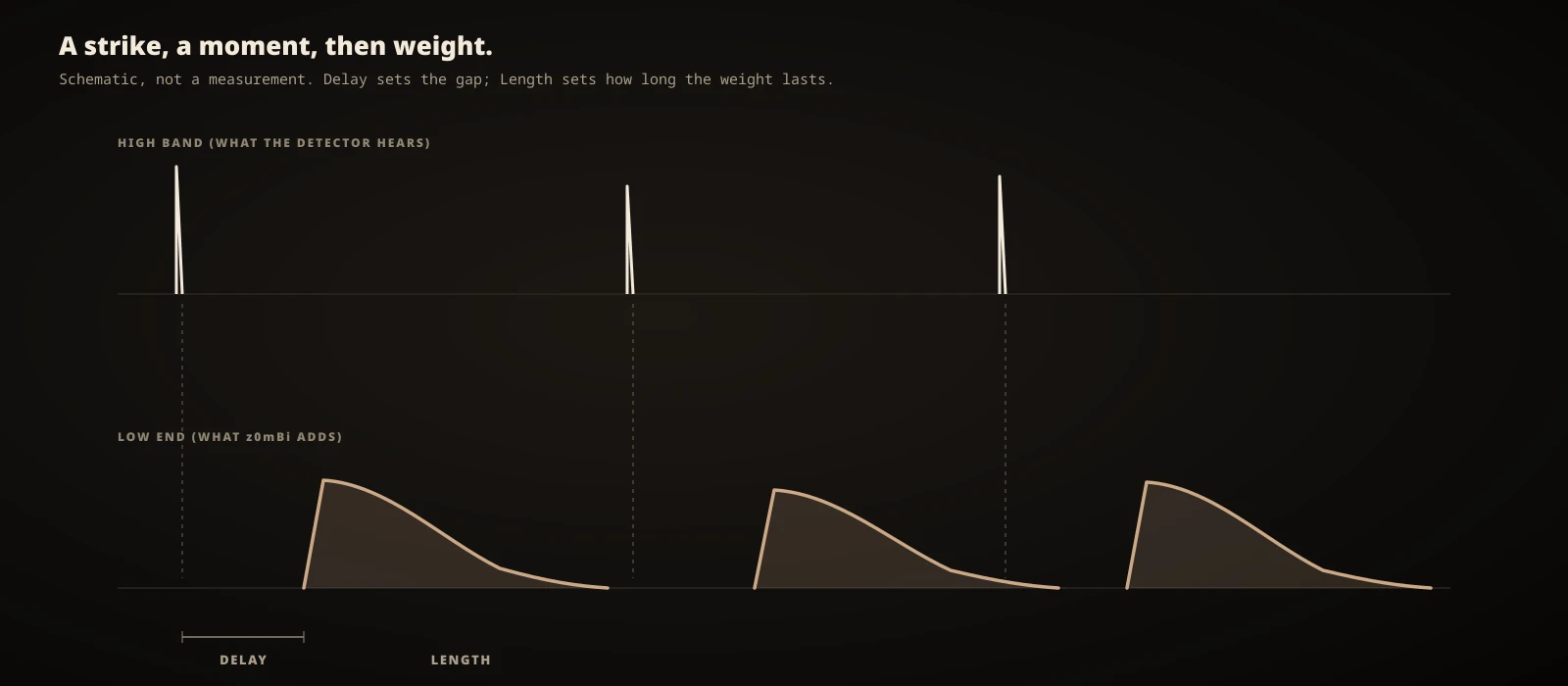
A detector watches the 3–12 kHz band and compares the last 3 ms with the last 100 ms. When the rise passes your Sensitivity setting, that is a strike. After your Delay, the weight swells in 5 ms and fades over your Length. A strike during a fade restarts the swell, so weights never stack above full.

In Reinforce, the weight is the track's own low end, shaped by a phase-rotating low-frequency filter cascade (Airwindows SubsOnly arithmetic). Some bands add and some dip while it is open, and that interference is part of the character. In Synthesize, it is a new sub thump made from the strike's own envelope, so a harder hit brings a bigger thump. It never lands earlier than 15 ms after the strike.

Signal Path

The dry signal never changes.

The weight is built from a copy of your signal and added to the untouched dry signal. At Relation 0, or in Bypass, the output is the input, bit for bit. There is no look-ahead, no latency and no limiter.
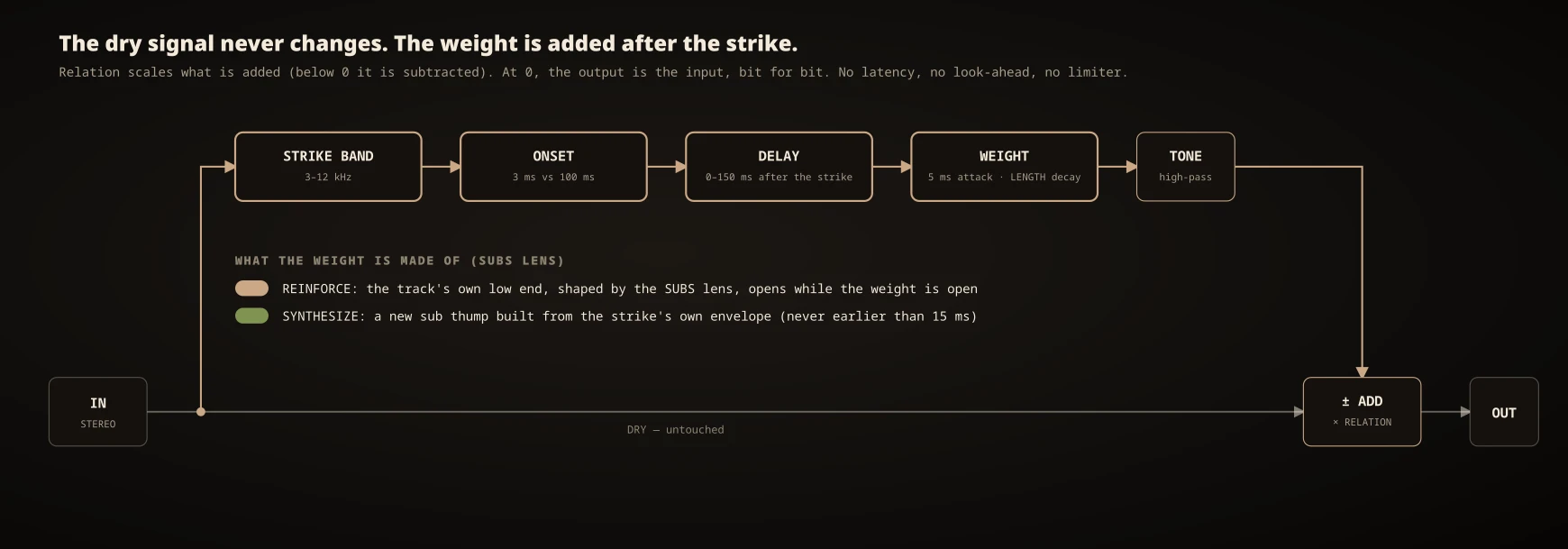
z0mBi signal flow. The stereo input goes straight to the output untouched. A copy feeds the strike band (3 to 12 kHz), the onset detector (3 ms against 100 ms), the delay (0 to 150 ms), the weight (5 ms attack, Length decay) and the tone high-pass, then is added to the dry signal, scaled by Relation. Reinforce uses the track's own low end through the SUBS lens; Synthesize uses a new thump built from the strike's envelope.
Strike band, onset, delay, weight and tone, added to the untouched signal.
A schematic timeline: high-band strikes shown as three sharp spikes on the top line, and under each, after a gap labelled Delay, a bone-coloured weight that swells quickly and decays over Length.
A strike, a moment, then weight. Schematic, not a measurement.
Controls

Four knobs, two lists, one switch.

Sensitivity9 … 2.5 dB, default 4.5How big a rise counts as a strike. Clockwise means more strikes. The light beside the knob flashes on every strike it finds.
Delay0 … 150 ms, default 60Where the weight lands after the strike. Synthesize never lands before 15 ms.
Length30 … 400 ms, default 150How long the weight lasts.
Relation−100 … +100 %, default +20The one level control. 0 is the input, bit for bit. Below 0, the weight is subtracted.
ModeReinforce · SynthesizeYour own low end, or a new sub thump.
ToneFull · FocusedKeeps the weight tight. Reinforce: none or an 80 Hz high-pass. Synthesize: 30 or 40 Hz.
SolotogglePlays only what z0mBi adds.
Interface

Bone, with a light for every strike.

One compact row: Sensitivity on the left with its strike light, Delay, Length and Relation in the middle, and the mode, tone and solo controls on the right. The sprout shows the value readouts. It is drawn with vector primitives in the shared BeanStalk family style, resizable and aspect-locked.
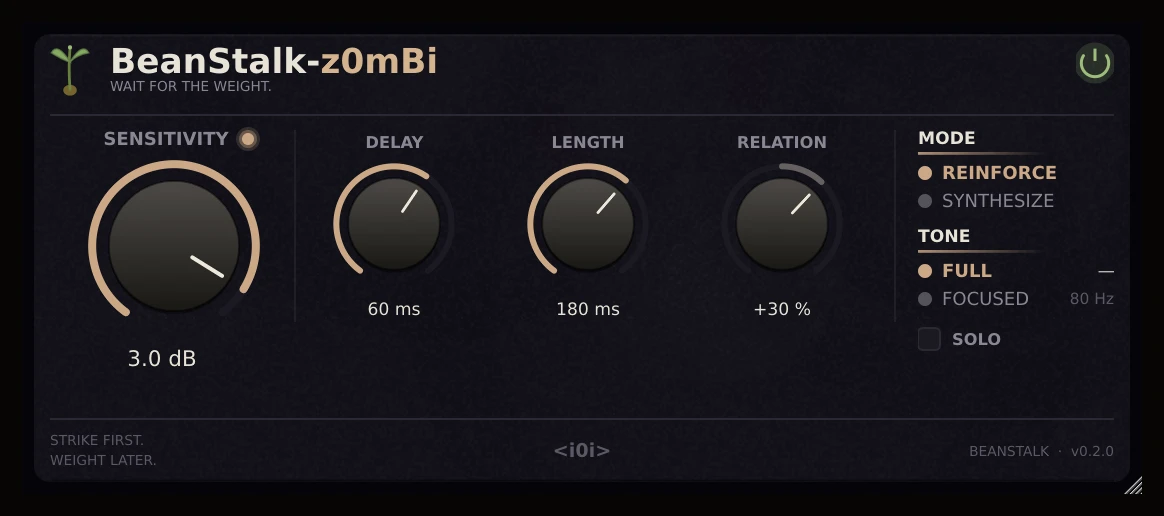
The BeanStalk-z0mBi front panel: a compact near-black panel. Top left, a small bean-sprout mark; the title 'BeanStalk-z0mBi' with 'z0mBi' in bone and the subtitle 'WAIT FOR THE WEIGHT.'; a power icon top right. Left, a large SENSITIVITY knob with a small strike light beside its label; in the middle, DELAY, LENGTH and RELATION knobs; right, a MODE list (REINFORCE lit, SYNTHESIZE), a TONE list (FULL lit, FOCUSED) and a SOLO checkbox. Footer: 'STRIKE FIRST. WEIGHT LATER.', a centred '<i0i>' and 'BeanStalk v0.2.0'.
The front panel, with the value readouts shown.
A few things to know before you download
What it isn't

Read this before you download.

No output limiterOn purpose. On a loud finished master, the three starting settings raised the true peak by about 1.6–2.8 dB in our measurements. Leave headroom, or turn Relation down.
It needs strikesDrums, plucks, picked notes and other percussive hits. A sustained pad has no strikes to find.
Low Sensitivity can catch fewerBelow about 3 dB, on dense material the detector can wait longer to re-arm, so it may catch fewer strikes, not more. The light shows what it catches.
Reinforce rotates phaseSome low bands dip while the weight is open. Try Synthesize or Focused if you hear it.
Technical details and verified specs
Technical

Verified specifications.

FormatVST3
Operating systemsWindows (64-bit) · Linux (64-bit)
ChannelsStereo in / stereo out
LatencyNone, no look-ahead
Sample ratesAny host rate; tested at 44.1 / 48 / 88.2 / 96 / 176.4 / 192 kHz
OversamplingNone
Neutral behaviourRelation 0 and Bypass are the input, bit for bit
CPUDSP about 0.2 % of one core at 48 kHz
Version0.2.0

Wait for the weight.

VST3, Windows and Linux. More platforms may follow.

Get z0mBi on Gumroad

DSP Lineage & Attribution: This plugin incorporates adapted DSP components from Airwindows (Chris Johnson, MIT licensed): SubsOnly. The specific components and applicable notices are documented in the included THIRD_PARTY_NOTICES.md. This does not imply endorsement by or affiliation with Airwindows.