BeanStalk Plugin

t0pS

Peak dynamics, reimagined. A look-ahead peak ceiling with four characters to choose from.

Drive · Character · Ceiling

Hold the peak. Choose how it is held.

t0pS is a look-ahead peak ceiling. Push the signal in with Drive, set the Ceiling, and pick one of four Characters that decide how each peak is brought down. Solo plays only what it took away.

Get t0pS on Gumroad Pay what you want · free · VST3 · Windows + Linux · more platforms may follow
t0pS
Built byBean.S.talk · BeanStalk Audio
Statusv0.1.0 · Windows + Linux. More platforms may follow.
What is it?

So, what does it do?

Instead of one limiting curve, t0pS has four ways of handling a peak, one selected at a time. Character 1, c0nfIne, multiplies by a gain dip. 0pp0se (two variants) subtracts a short low-frequency-weighted pulse. abS0rB subtracts a pulse shaped by the locally dominant band. All four report the same latency, so you can switch while listening.

It is built for mixing and mastering at practical buffer sizes, with higher latency and CPU than a simple limiter in exchange for the sound.

Curious how it works?
The Concept

One ceiling, four ways to meet it.

c0nfIne (the default) is the streaming Field engine: it finds each peak and applies a smooth gain dip. 0pp0se and abS0rB work differently: for each reconstructed peak above the ceiling they subtract a short pulse (a Hann pulse, a Hann pulse shaped by local autocorrelation, or a pulse tuned to the locally dominant band) sized so the reconstructed peak lands on the target, and undo it if it made things worse. A one-stage gain fallback is always behind them. Peaks are judged on a 16-phase reconstruction of the signal.

Each channel is corrected on its own. Switching Character is silent for about one latency while the new engine fills.

Signal Path

Drive in, delay, correct, ceiling out.

The input is driven, analysed ahead of time, and the correction is applied to a delayed copy of the signal, so the correction lines up with the peak it was made for.

t0pS signal flow: input, Drive, a look-ahead analysis running ahead of a delay, the selected Character's correction (c0nfIne gain dip, 0pp0se pulse or abS0rB pulse), output at the Ceiling; Solo plays the difference.
Drive, look-ahead analysis, the selected Character's correction, and the ceiling. Solo plays the difference.
Controls

Three knobs, a switch, a glyph.

Drivegain in dBHow hard the signal is pushed into the ceiling.
Characterfour detents1 c0nfIne (default), 2 0pp0se Hann, 3 0pp0se PSD, 4 abS0rB band. The name shows under the knob.
CeilingdBFSThe level peaks are held to.
SolotogglePlays only what t0pS removed: the aligned output minus the driven input.
Power lightbypassBypass, latency-aligned. Also the host's bypass parameter.
<i0i>glyphOpens the Solo drawer above the footer. Closing it keeps Solo as set.
Bean sproutreadoutsClick to show numeric values; hidden by default.
Interface

Olive and dark, three knobs.

Small Drive and Ceiling knobs flank a larger four-detent Character knob. The values stay hidden until you click the sprout. The window scales as one, with a minimum and maximum size.
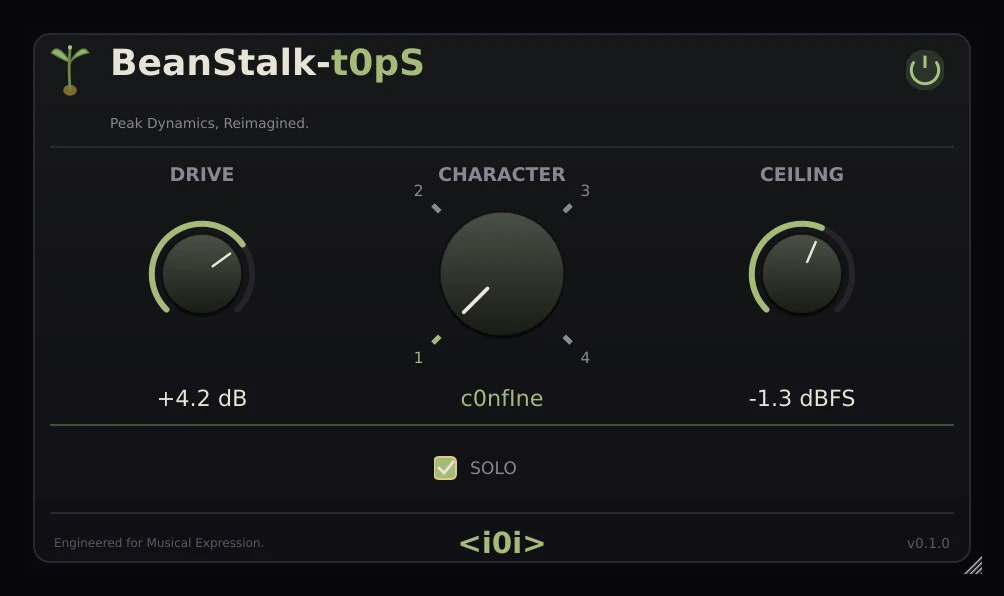
The BeanStalk-t0pS front panel: title 'BeanStalk-t0pS' with the subtitle 'Peak Dynamics, Reimagined.'; DRIVE (+4.2 dB), a larger CHARACTER knob with four numbered detents and the name c0nfIne, and CEILING (−1.3 dBFS); a SOLO checkbox; footer with 'Engineered for Musical Expression.', a centred <i0i> and v0.1.0.
The front panel with values shown (the plugin's own editor rendered headless; demo settings).
A few things to know before you download
What it isn't

Read this before you download.

LatencyAbout 2112 samples at 48 kHz (2049 at 44.1, 3778 at 88.2, 3904 at 96 kHz), the same for all four Characters. Your host compensates.
CPUThe 0pp0se and abS0rB characters do more work than c0nfIne; heavy material at tiny buffers can exceed the work budget, and missed deadlines are possible. We have verified correctness and stability at practical mastering buffers (512 and 1024), not flawless 32 or 64 sample operation.
Switching CharacterInterrupts the output for about 44 ms at 48 kHz while the new engine fills.
No ceiling guarantee claimedWe do not claim a guaranteed true-peak ceiling for every host and material.
Not yet checkedLive DAW GUI, high-DPI and Windows host checks have not been done by us; there has been no listening panel.
Technical details and verified specs
Technical

Verified specifications.

FormatVST3
Operating systemsWindows (64-bit) · Linux (64-bit)
ChannelsMono or stereo; each channel corrected on its own
Latency2112 samples at 48 kHz; 2049 / 3778 / 3904 at 44.1 / 88.2 / 96 kHz
Characters4: c0nfIne, 0pp0se Hann, 0pp0se PSD, abS0rB band
ParametersDrive, Character, Ceiling, Solo trim, Bypass
Version0.1.0

Peak Dynamics, Reimagined.

VST3, Windows and Linux. More platforms may follow.

Get t0pS on Gumroad

More BeanStalk plugins

See all plugins →